

Is your hearing keyboard not working?
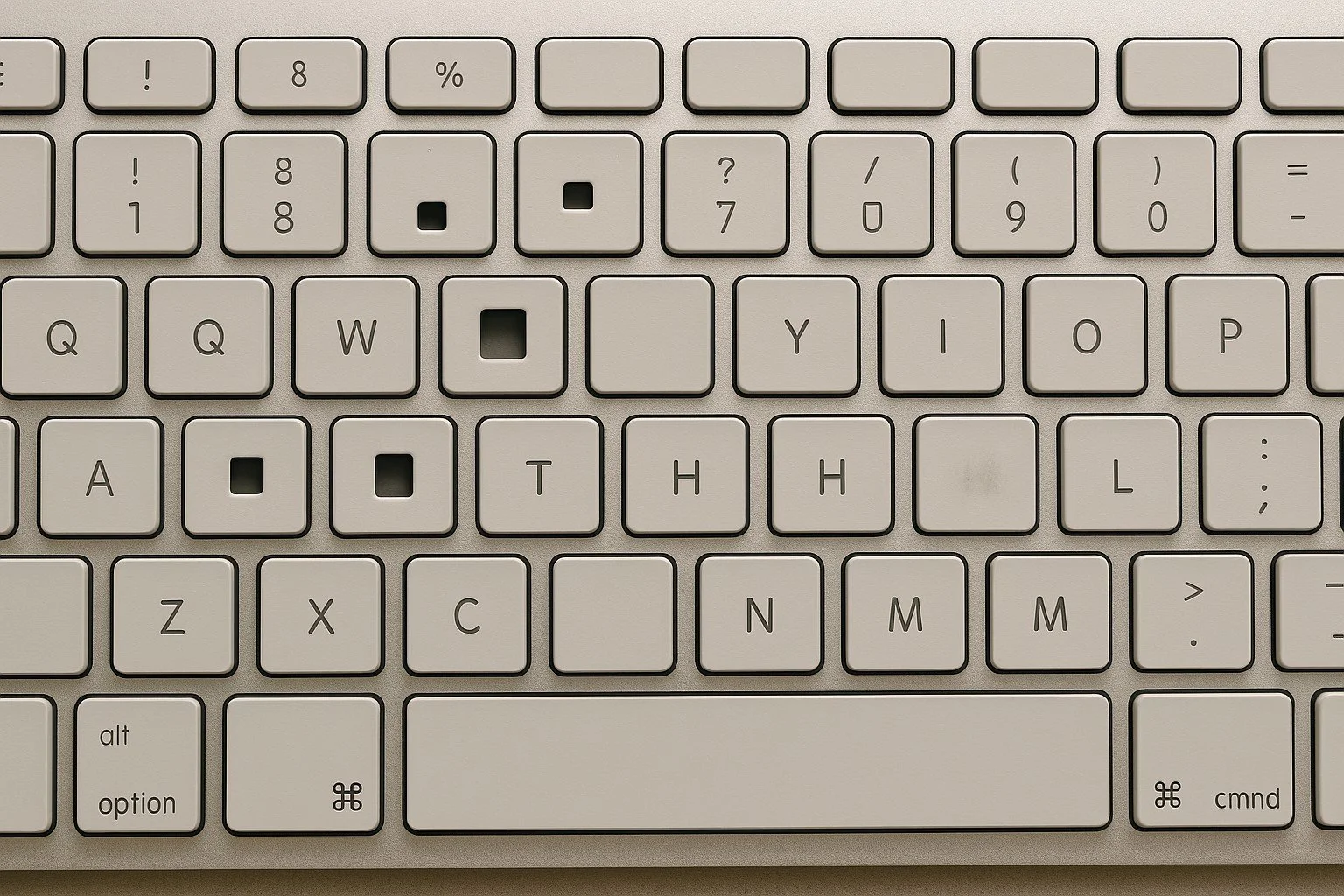
If you’ve ever tried to explain hearing loss to someone who hasn’t experienced it, you’ll know it can be tricky. One analogy that really clicks—especially for younger boomers who grew up with early computers—is the “Broken Keyboard” analogy.
Think of your ears as the keyboard and your brain as the CPU. Even if the CPU is lightning‑fast, it can only work with the information it receives. If the keyboard is faulty, the output will be messy, confusing, or just plain wrong. Hearing works the same way: if the input is damaged, the brain has to guess, fill in gaps, or work overtime to make sense of things.
Let’s break it down.
1. Missing Keys = Missing Frequencies
Imagine typing a sentence, but the E, S, and T keys don’t work.
You try to type: “The test is easy.”
But the computer receives something like: “Th_ _ _ i_ _a_y.”
Now the CPU has to guess what you meant. That’s exactly what happens when you lose high‑frequency hearing.
Vowels (A, E, I, O, U) are low‑frequency and usually stay intact.
Consonants (S, T, F, K, SH, TH) live in the high frequencies and often disappear first.
So instead of hearing clear speech, you get something that sounds like a puzzle with pieces missing. Your brain tries to fill in the blanks, but it’s exhausting and not always accurate.
2. Sticky Keys = Distortion
Now imagine a different problem: You press the E key once… and it types “eeeeeeeeee.”
Annoying, right?
This is what distortion feels like in hearing loss. Sometimes the cochlea doesn’t just miss sounds—it sends extra, blurred, or warped signals.
Your brain receives:
Noise that shouldn’t be there
Sounds stretched out or smeared together
A messy version of what was actually said
It’s like trying to read a sentence while someone keeps tapping random keys on your keyboard. The message is still there, but it’s buried under “mechanical” errors.
Why This Analogy Matters
People often assume hearing loss is just about “turning up the volume.” But as this analogy shows, it’s really about clarity, accuracy, and signal quality.
A broken keyboard doesn’t get better by turning up the screen brightness. And a damaged cochlea doesn’t magically fix itself by turning up the TV.
Understanding this helps people appreciate:
Why hearing aids focus on clarity, not just loudness
Why speech can sound muffled or distorted even with amplification
Why listening fatigue is real—your brain is constantly guessing and correcting